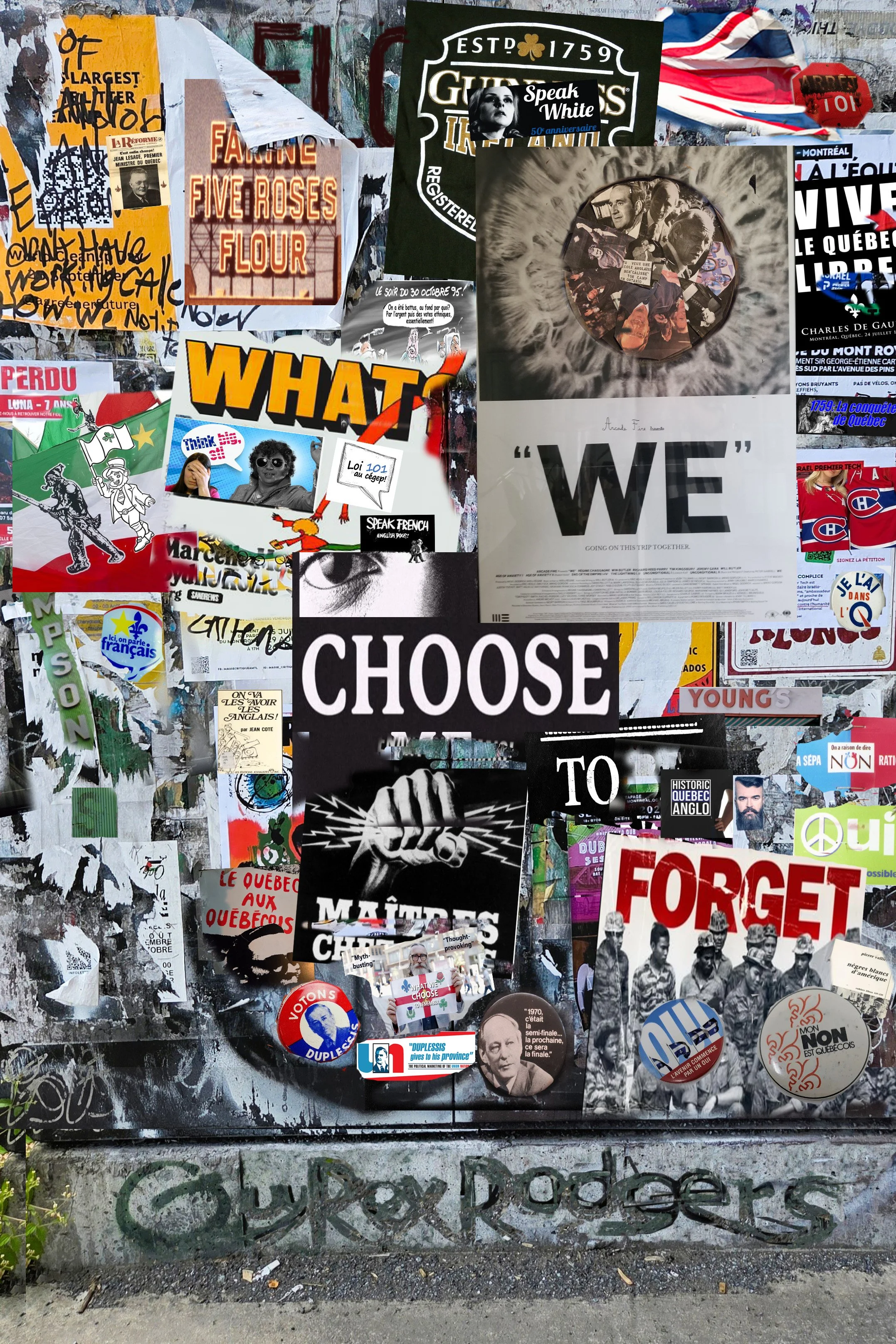
What We Choose To Forget:
A Quebec Story of Unshared Memories
About the Book
In May 2022, Guy Rex Rodgers released a documentary film about waves of immigration in Quebec, from the British Conquest to the arrival of university students in the 21st century. A month later, the CAQ government passed Bill 96 to protect Quebec from too many English speakers, immigrants and foreign students. For the next three years, Rodgers toured his film to every region of Quebec, and after each screening invited audience members to share their stories. The collective portrait that emerged explodes some of Quebec’s most persistent myths about who is Québécois.
The heartland of Nouvelle France was the Saint-Lawrence Valley but it was never pure Catholic or francophone. Scottish and Irish soldiers fought on both sides of the Plains of Abraham. The first English school established after the Conquest was not in Quebec City or Montreal but in the Gaspésie. The first immigrant settlements in the Eastern Townships and the Ottawa Valley were established by English speakers. Then the 20th century saw an explosion of immigration that did not fit the French/English, Catholic/Protestant binary. The reality is far more interesting than Two Solitudes.
These ‘immigrants’ — who come from different places and speak a variety of languages — are proud to be Quebecers. During the CAQ era of Bill 96, they were treated as a problem and a threat to Quebec. What We Choose To Forget gives a voice to ‘outsiders’ who have a lot to say about Quebec and their place in it!
BLURBS
-
Review of What We Choose to Forget
What We Choose to Forget documents the third leg of a personal journey of discovery by Guy Rodgers, a longtime Montreal arts promoter, writer, musician and multimedia creator. The first leg began as a series of filmed interviews he organized during the pandemic with members of Quebec’s diverse English-speaking community, or rather, communities. These were first identified as emerging from waves of immigrants arriving from England, Ireland and Scotland in the 18th and 19th centuries, and concluding with those from continental Europe, Asia, Africa and Latin America in the recent past and present.
What We Choose to Forget is an impressive piece of work. Rodgers has a narrative skill that makes for a read that flows like water, at one level offering fly-on-the-wall descriptions of friendly encounters with a wide range of Quebecers, at another an eye-opening discovery of hidden truths they reveal about our history, or histories. Its great strength, like that of the film, What We Choose to Remember, is that the characters deliver the messages by relating their own stories, without artifice and without grating arguments or divisive polemics.
Guy Rodgers’s journey, as documented in the film and the book, explodes myths about Quebec’s roughly one million English-speakers. By tracing their origins and extracting individual stories, he unveils a remarkable variety within this linguistic minority. It embraces the so-called historic Anglos, of course, but also deeply-rooted immigrants, many of whom became anglos here, such as the Italians in east-end Montreal Island—he describes the St-Léonard episode—as well as Eastern European Jews who found refuge in Quebec from pogroms and the Shoah.
Among these last, Rodgers has stumbled upon a phenomenon. In showing the film, he kept hearing from people who came to Quebec in the 1950s and 60s who said they wanted to attend then-Roman-Catholic French-language schools, but were turned away. This has been denied by at least one francophone historian, but Rodgers heard personal accounts of such experiences too numerous to ignore or deny. Now he is working on documenting an inconvenient truth: that before Bill 101, many immigrant children learned English in English schools not because they chose this path, but rather because Quebec’s French schools would not accept them.
Guy Rodgers is telling English Quebecers our history in a novel way. Multimedia artist that he is, he has offered up a film, a series of live encounters, and a book, all of which convey experiences and insights that will change the way you understand Quebec's biggest minority. If you are part of it, the stories will make you proud and remind you that this is your home. If you are not part of it, they will show you that Quebec’s English-speaking communities are a valuable part of the province’s social, cultural, economic and political fabric.
Christopher Neal is a Montreal-based writer, retired journalist and communications manager.
-
Blurb for What We Choose To Forget
Guy Rodgers has a remarkable ability to reveal the humanity that lies beneath Quebec’s complex history and politics. He demonstrated this with great sensitivity and finesse in his documentary What We Choose to Remember. His new book, fittingly titled What We Choose to Forget, builds on that work with depth and insight.
In this book, Rodgers captures the essence of life in Quebec for those of us outside the francophone majority. He brings to light the stories of lesser-known regions and communities across our beautiful province, doing so in a way that reflects who we are as Quebecers. Ours is a complex society that resists simple explanations, yet he opens this world with clarity and grace, helping us better understand ourselves while offering the rest of the country a window into our lived reality.
I strongly recommend this thoughtful and engaging book.
Frank Baylis P. Eng.
Co-Executive Chairman / Baylis Medical Technologies Inc.
Former MP Dollard-Desormeaux
-
Why Quebec Cannot Move Forward Without Facing What It Chooses to Forget
In Quebec, calls to “move forward” often surface when debates over language, identity, or minority rights grow uncomfortable. The implication is that the past is an obstacle—and that progress depends on leaving it behind. What We Choose to Forget, by Guy Rex Rodgers, thoughtfully challenges that assumption.
Drawing on years of documentary filmmaking and conversations in more than fifty communities across the province, Rodgers examines how relations between francophones, anglophones, and allophones were shaped—not accidentally, but historically. His approach is not polemical or accusatory. It is patient, humane, and deeply grounded in lived experience, attentive to voices and histories that are too often missing from Quebec’s dominant narrative.
Quebec’s modern identity has rightly been shaped by a history of conquest and cultural marginalization. That underdog story remains powerful and meaningful, and Rodgers treats it with respect. But he also shows it is incomplete. Alongside it exists lesser-known histories of anglophone and immigrant communities who helped build Quebec and who also experienced insecurity, displacement, and uncertainty—particularly during periods of political and linguistic upheaval.
One of the book’s most revealing and quietly moving examples concerns education. Long before contemporary language laws, French Catholic schools routinely excluded children who were Jewish, Protestant, non-Catholic, or otherwise outside the traditional “de souche” framework—sometimes even when French was their only language. Many families were redirected, by necessity rather than choice, into English institutions. This largely forgotten history adds nuance to today’s debates and complicates the familiar assumption that English schools simply reflected privilege or domination.
These stories are not always denied outright; more often, they are absent. The result is not reconciliation, but mutual incomprehension. Francophones may struggle to understand why English-speaking minorities express vulnerability in a world dominated by English, while anglophones and allophones often underestimate how deeply historical insecurity continues to shape francophone political instincts. Rodgers approaches these tensions with empathy rather than judgment.
He does not promise comfort. On the contrary, he suggests that a measure of discomfort is both honest and necessary. Thoughtful history unsettles neat moral categories and challenges easy divisions between victim and oppressor. Yet Rodgers is ultimately constructive: his work insists that understanding, not amnesia, is the foundation for healthier relationships.
What We Choose to Forget offers no manifesto and no policy prescriptions. What it provides instead is something rarer in Quebec’s language debates: historical clarity, conveyed with care and respect. If the province hopes to build more confident, generous, and durable relationships between its communities, Rodgers suggests, that effort must begin by facing what has too often been left unexamined.
Richard Walsh Smith
educator, writer and activist
-
What We Choose to Forget: The Québec Nation Considered
This book is a must-read for anyone seeking an informed and nuanced understanding of the Québec nation: where it came from, where it is going, and the ultimate question - Who is a Québecois? Rodgers is to be particularly commended for challenging the decades-old false narrative that immigrants have rejected the French language.
I reached out to Rodgers after reading his September 2023 column in The Montrealer and then watched his film “What We Choose To Remember.” I was struck by the interview given by a Québecer who, like myself, was the son of Italian Catholic immigrants who came to Québec during the 1950’s. He spoke of his parents’ attempt to enrol him in a French Catholic school, then being denied enrollment and directed to an English school because his parents were immigrants. This was a profoundly relatable story as I had experienced the same rejection, and the same response over the years from francophone colleagues, who had never heard about this happening or did not believe it.
I knew that this experience was not anecdotal but systemic in nature and felt compelled to engage in advocacy on this issue. Rodgers and I jointly hosted a town hall community meeting in December 2024. After a screening of “What We Choose To Remember” audience members recounted their experiences with Québec’s French Catholic Schools during the 1950’s and 1960’s.
Meanwhile, Rodgers received funding from the Secrétariat aux relations avec les Québécois d’expression anglaise, to engage in a two-year study recording the experiences of students of not only Italian catholic but also non-Catholic immigrants with French Catholic schools prior to 1977. This study presents clear evidence of the rejection of immigrant children by French Catholic schools and their diversion to English schools prior to the 1977 adoption of the Charter of the French Language. Notwithstanding an acknowledgement by Union Nationale Premier Daniel Johnson Sr in June of 1968 and by Pauline Marois in 2025, too many politicians and pundits continue to deny that this historical injustice ever occurred. The final chapter of the book presents an investigation into education, immigration and language laws from an eyewitness, immigrant perspective.
Certain politicians have engaged in a strategy that seeks to erase the deep historical roots of the English language in Québec, its defining impact on Québec society and the centuries-long tradition of linguistic tolerance and collaboration between French and English speaking Québecers. Politicians have attempted to create a unilingually French speaking Québec inconsistent with our history by trying to diminish the English language to folkloric status.
“What We Choose To Forget” eloquently speaks to the pride, resilience and confidence of English-speaking Québecers to continue to live in and contribute to the Québec of tomorrow. All indicators foretell the continued currency of the English language and its pertinence to the future prosperity of Québec.
Ralph Mastromonaco
Criminal defence lawyer and human rights activist
-
Thoughts About What We Choose To Forget
Memory is a funny thing. It’s selective. We remember some things well; other things, we might just prefer to let slide.
So says the neuroscience of memory, and the psychology of memory as well.
Research has also shown that memory is dynamic: any time a memory is recalled, it becomes temporarily unstable and can be recoded and stored away again differently. New information, new experiences and new emotions can reshape memories.
With his 2022 documentary film, What We Choose to Remember, and this companion book, What We Choose to Forget, Guy Rodgers explores this role of memory in the outlook and sense of belonging of English-speaking Quebecers.
What We Choose to Remember is Rodgers’s feature-length film that opened at the Hudson Film Festival in May of 2022. It grew out of a six-episode documentary series, Waves of Change, that aired a year before on MAtv, as well as on the CBC as a shorter one-hour telecast, Waves of Change: Reimagining Quebec.
Waves of Change features the testimonies of 30 Quebecers, anglophones and as well as allophones who identify with the anglophone experience – all of whom came to Quebec, or whose ancestors came to Quebec, during different waves of immigration going back two centuries. Most of these people live in and around Montreal. There’s a separate episode devoted to others who were born or raised in, or immigrated to, regions outside of Montreal as far away as the Lower North Shore region bordering Labrador.
Taken together, these oral histories combine to give a nuanced portrait of the collective zeitgeist in the English-speaking community of Quebec. In short, it’s complicated.
After the Hudson Film Festival, Rodgers took his film across Quebec and showed it to different audiences in cities and towns with English-speaking minority populations. What We Choose to Forget is the story about that film tour.
Rodgers artfully weaves into the different chapters of the book the local history of the places he brought the film. And he carefully records the reactions to the film expressed by the hundreds of people who came to see it - and to share their own stories as well.
And then there’s this: It just so happens that while Rodgers was touring Quebec, the government of Quebec was in the early stages of implementing Bill 96, legislation to introduce new restrictions on English in the name of promoting French. This was new information being dropped into the discussions. And as the research shows, new information, new experiences and new emotions can transform memories.
Memories, then, are more like paintings that are continual works in progress rather than fixed thoughts or video recordings. You can see in What We Choose to Forget the effect that Bill 96 is having on identify and a sense of belonging in Quebec.
I like all these oral histories in the Waves of Change project. There’s an intimacy and frankness to them. They’re like private confessions. We haven’t had very many deeply personal conversations in the English-speaking community about political and sociological change like the ones featured in the Waves of Change project. This is valuable piece of sociological work. And What We Choose to Forget, the conclusion to the project, is a welcome addition to the published works relating to the place of English and the English-speaking community in Quebec.
David Johnston
Reporter and editor, The Gazette, 1981-2014
Quebec and Nunavut regional representative of the federal commissioner of official languages, 2014-22
-
Review of What We Choose To Forget
Guy Rex Rodgers’ What We Choose to Forget underscores both the vitality and trepidation of Quebec’s English-speaking communities in the 21st century. By going beyond the familiar confines of Montreal, the book gathers together the many and often forgotten anglophone communities that pepper Quebec’s rural hinterland. But Rodgers doesn’t just cast his net geographically, he also includes the voices of many allophone Quebecers - those whose first language is neither English nor French – highlighting the increasing diversity of non-francophone life in the province. From the Ontarian border to Baie-Comeau, and from the Eastern Townships to Rouyn-Noranda, What We Choose to Forget allows anglophone and allophone Quebecers to give voice to their pride, their frustrations, and even their blessings when calling ‘la belle province’ home.
More than many other North American societies, Quebec has undergone profound social and cultural changes since the revolutionary decade of the 1960s, and the province’s English-speaking communities have been, at times, not just the witness, but also the target of these social and cultural changes. Non-francophone peoples have been established in Quebec since the time of New France, but their presence has often been occluded by a sovereigntist interpretation of history that situates Anglo-Quebec as the product of an economic elite that marginalized the francophone majority for close to two centuries.
Rodgers is especially attentive to how history has been shaped by the politics of memory, and how the lived realities of Quebec’s anglophone communities don’t tie in with the simplistic caricature of an “economic-elite”. By contextualizing personal stories within the broader sweep of Quebec’s economic development—particularly alongside the generational changes of their francophone neighbours—we get to see how each community prospered or struggled in the great unfolding of Canadian history.
While language laws and cultural ordinances have made life more difficult for non-francophone Quebecers, what comes through in Rodgers’ work is the raw humanity of his subjects. Language has never been a barrier in smaller communities, whenever your neighbours need help building a playground, a school, or a community centre. In an increasingly online world of anonymous rancour and op-ed outrage, What We Choose To Forget highlights the value of face-to-face communication and the difficulty any government will have in regulating the everyday and spontaneous interactions of its citizens.
Rodgers’ work updates the historical conversation first established by Ronald Rudin’s The Forgotten Quebecers and Clift and McLeod’s The English Fact in Quebec. The inclusion of allophone voices is especially pertinent given the changing demographics of the province. For future historians, What We Choose To Forget will doubtless become indispensable to a historical understanding of Anglo-Quebec in the first half of the 21st century.
Raymond Jess PhD
School of Irish Studies
Concordia University
-
Review of What We Choose To Forget
Guy Rodgers has produced an important and original exploration of Quebec's many and diverse English-speaking communities. We hear their own voices and the author's perceptions as well. The materials dealing historically with the Quebec education system, especially with issues relating to the acceptance or non-acceptance of immigrants ("allophones") into the French Roman Catholic schools is particularly well researched and explained.
In Rodgers' great project we meet everybody and see, in depth, the variety and creativity found throughout English-speaking Quebec. This work is light in tone and fascinating to read as we meet such a cross-section of people, but it is also essentially very serious in
intent.
I was pleased to see mentioned many of the important literary works of Quebec like Trente Arpents and Maria Chapdelaine. So few (especially English-speakers) seems to have read them, although excellent translations have been available for years. I think it's important that literary, musical and other arts-related areas be included in the story of Quebec. It creates a fuller picture of our culture and history - beyond just politics and facts.
Sandra Stock
Director, Quebec Anglophone Heritage Network.
Ce qu'on choisit d'oublier : Récits non partagés de souvenirs sélectifs
À propos du livre
En mai 2022, Guy Rex Rodgers a sorti un documentaire sur les vagues d'immigration au Québec, de la conquête britannique à l'arrivée des étudiants universitaires au XXIe siècle. Un mois plus tard, le gouvernement de la CAQ adoptait la Loi 96 afin de protéger le Québec d'un trop grand nombre d'anglophones, d'immigrants et d'étudiants étrangers. Pendant les trois années suivantes, Rodgers a présenté son film dans toutes les régions du Québec et, après chaque projection, il invitait les spectateurs à partager leurs témoignages. Le portrait collectif qui en a résulté a fait voler en éclats certains des mythes les plus tenaces sur l'identité québécoise.
Le cœur de la Nouvelle-France était la vallée du Saint-Laurent, mais elle n'a jamais été exclusivement catholique ni francophone. Des soldats écossais et irlandais ont combattu des deux côtés des plaines d'Abraham. La première école anglaise établie après la Conquête n'était ni à Québec ni à Montréal, mais en Gaspésie. Les premiers établissements d'immigrants dans les Cantons-de-l'Est et la vallée de l'Outaouais ont été fondés par des anglophones. Puis, au XXe siècle, une immigration massive a déjoué
la dichotomie franco-anglaise et catholique-protestante. La réalité est bien plus complexe que ne le suggère le roman « Deux Solitudes ».
Ces « immigrants » — originaires de divers horizons et parlant une variété de langues — sont fiers d’être Québécois. À l'époque de la CAQ et de la Loi 96, ils étaient perçus comme un problème et une menace pour le Québec. Le livre « Ce qu'on choisit d'oublier » donne la parole à ces « étrangers » qui ont beaucoup à dire sur le Québec et leur place au sein de la société !

Partners