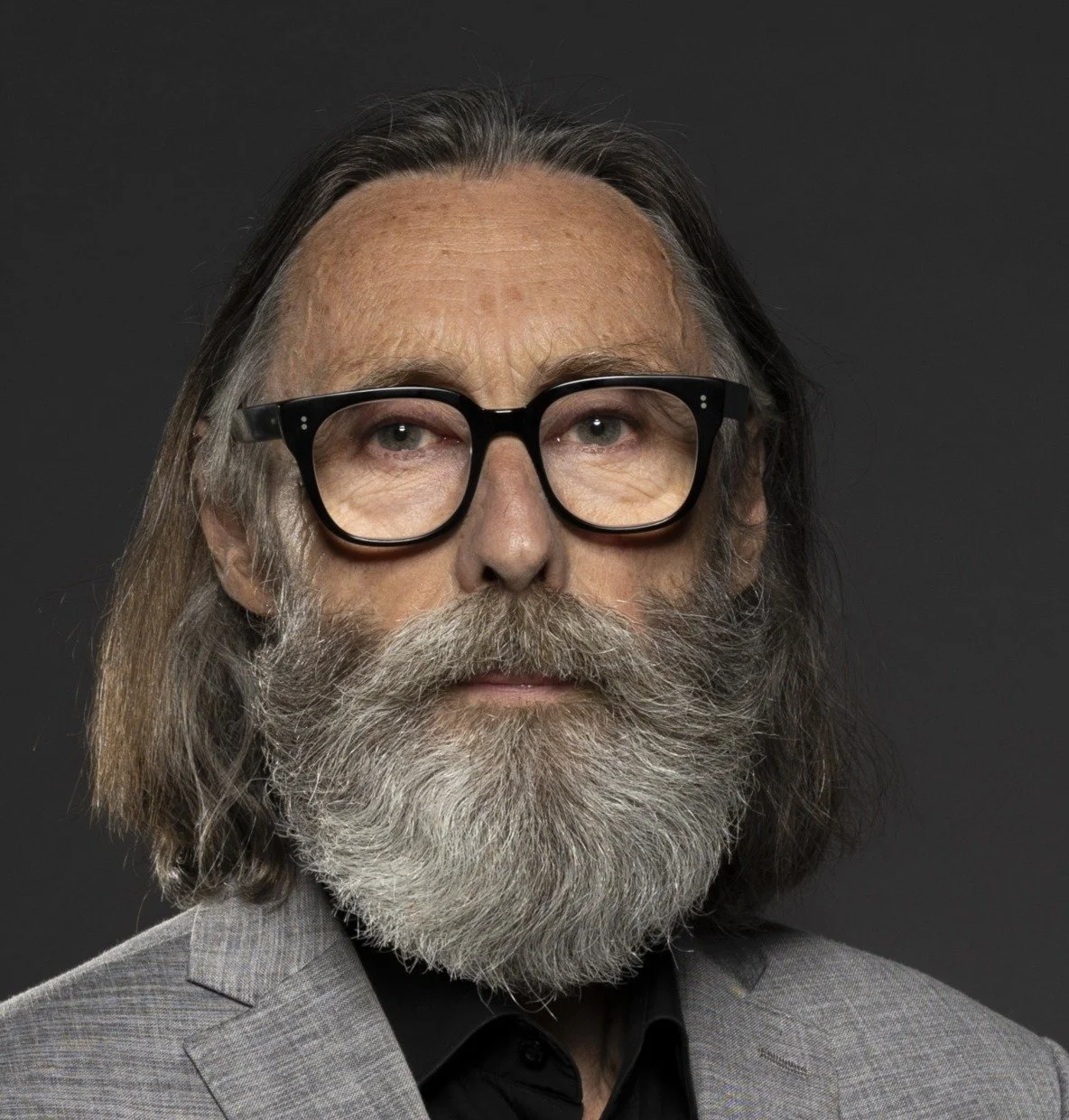
Photo by Pantea Pezeshkan
Guy Rex Rodgers arrived in Quebec as a young adult to study at the National Theatre School, and was immediately enamoured with, and often baffled by, Quebec’s history, culture and politics. Rodgers has been a writer, translator, filmmaker and community activist: founder of the English Language Arts Network (ELAN), co-founder of the Quebec Writers’ Federation (QWF) and the Quebec Drama Federation (QDF). In 2015, he was appointed a companion in l’Ordre des arts et des lettres du Québec. In 2020, Rodgers began filming a documentary about waves of immigration, and how immigrants successfully adapted to Quebec since it adopted the first language laws half a century earlier. His three-year tour of Quebec, as the government imposed harsh new language laws, is the story of What We Choose To Forget.
What We Choose To Forget is available in print form. It can also be downloaded as a PDF that contains hundreds of media hyperlinks for additional information at www.whatwechoose.ca
About the Author
A CONVERSATION WITH
GUY REX RODGERS
AUTHOR OF
WHAT WE CHOOSE TO FORGET
A QUEBEC STORY OF UNSHARED MEMORIES
You are a writer, filmmaker and community activist. Do you ever feel those different activities are at odds with each other?
The factors that unite them are curiosity and necessity. I came to Montreal to study writing at the National Theatre School after living the first 12 years of my life in Vancouver and then 13 years in Australia, so I knew almost nothing about Quebec when I arrived. I immediately identified quite strongly with francophone culture, and people were friendly because I was a foreigner who wanted to learn French. At a personal level, I felt welcome in Quebec, but I soon learned that Quebec’s hereditary ‘enemies’ were English-speakers and my ancestors spoke English. I could see I was no going to be a full member of the francophone community but I was not part of the historic Anglo community. Like a lot of immigrants I asked myself, ‘Where do I fit in here?”
I graduated from the National Theatre School and that was my first community, so I became the founding executive director of the Quebec Drama Federation. Writer friends asked me to help create a community association for them and I became founding president of the Quebec Writers’ Federation. Both organizations promoted dialogue with francophone artists. I was the first Anglo elected to the board of le Conseil Québécois du Théâtre and I was also appointed to the founding board of le Conseil des arts et des lettres du Québec.
My wife is francophone. From the very beginning of my life in Quebec, I have spent part of my time among English speakers and part among francophones. I have been fascinated by how they interact – or not – and why. That is why I made films about waves of immigrants. Quebec politics are often maddeningly binary: are you anglophone or francophone, separatist or federalist? The reality of most people’s lives is much more complex and interesting. I have tried to portray that in the documentary films I have made.
How did being a filmmaker and a community activist lead to writing this book?
I was still executive director of ELAN (English Language Arts Network) when Le Secrétariat aux relations avec les Québécois d’expression anglaise funded a community project about identity and belonging among English speakers in Quebec. I created six short documentaries based on waves of immigration. Those short films resonated so strongly that MAtv provided funding to expand them into six half-hour episodes, which became the TV series Waves of Change. CBC asked me to make a one-hour special about Anglos and allophones in Quebec, and the National Film Board provided assistance to create a feature length documentary that became What We Choose To Remember.
We started the project on the 50th anniversary of the FLQ crisis and it looked back at half a century of dramatic change in Quebec. I wanted to celebrate the role that Anglos and allophones played in adapting to the spirit of Bill 101. In the 1960s, Quebec had a lot to be angry about. Fifty years later there was a lot to be proud of, and English speakers played a significant role in the transformation, although that is not always recognized or appreciated.
Then I was invited to show my film all around Quebec, and every screening was followed by a conversation with the audience. They wanted to talk about their local communities and how they had changed over the years, mostly for the better. They also wanted to talk about Bill 96, which felt like an attack without justification. Half-way through the tour I realized that ‘what these people are saying is really important.’ That led to the idea of writing a book about what I saw and heard during the tour.
Bill 96 is mentioned briefly at the end of your film, but it becomes a major character in the book.
Yes. When we filmed the interviews, Bill 96 was just a proposition. Nobody knew where it was going to go. My film premiered at the Hudson Film Festival in May 2022. Bill 96 was adopted in June and it was designed to implement additional measures in June 2023 and June 2024. During those three years, I toured my film to 55 communities around Quebec.
What We Choose to Remember celebrated half a century of progress. Bill 96 was designed to fix half a century of failure. According to the CAQ government, the French language was declining, at least for mother-tongue francophones, and François Legault compared Quebec to Louisiana as a French society on the verge of extinction. Suddenly there were too many Anglos in Quebec and too much English everywhere. People who came to the screenings were initially puzzled, then they felt targeted and angry.
What would you like readers to take away from this book?
Two things.
First, I had the privilege of being invited to communities with deep, fascinating histories. I’d visited some of them before, but as a tourist you barely see a trace of the Anglo presence. The people who came to my screenings shared their stories, which present a remarkably multi-dimensional portrait for any reader who wants to understand Quebec in all its myth-defying complexity.
Second, it was pure happenstance that I toured Quebec during the three years that Bill 96 was making Anglos and immigrants feel unwelcome in Quebec. And it was pure happenstance that my film celebrated the previous half-century of Bill 101 as a success story, while the CAQ government was portraying Bill 101 as a total failure. The book documents these conflicts from the personal perspectives of hundreds of Quebecers: anglophones, allophones and francophones.
Your film was titled What We Choose to Remember. The book is called What We Choose To Forget. What is the difference between choosing to remember and choosing to forget?
One definition of reality is to agree upon a shared experience. Remembering includes other people and their experiences. It is a collective process. Forgetting is about erasure and cancellation. It is unilateral and can be brutal when exercised as a form of ethnic nationalism.
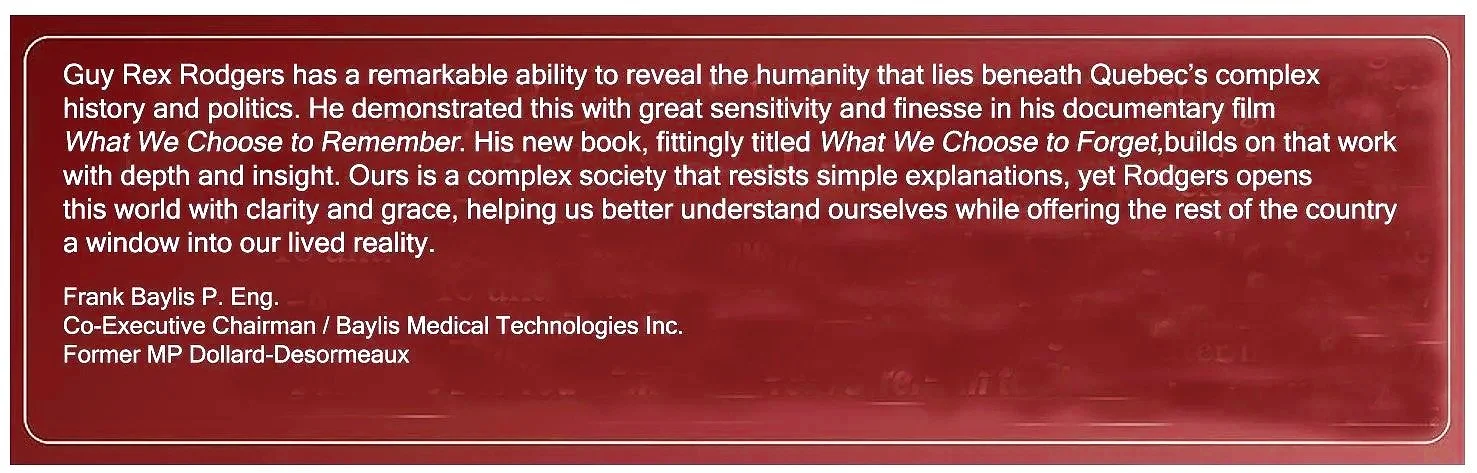
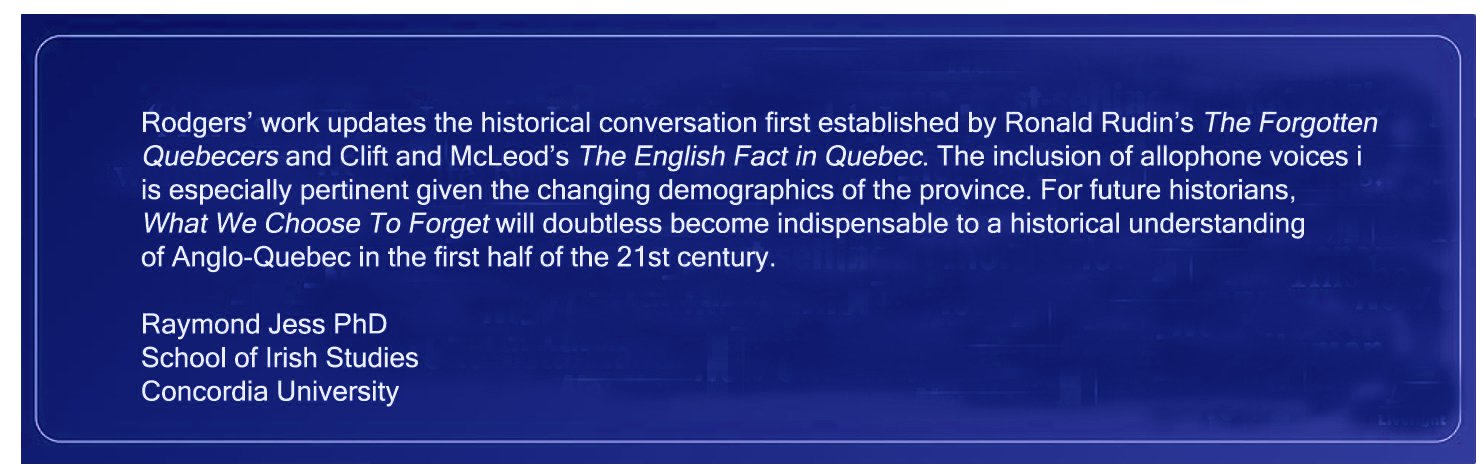
Photo de Pantea Pezeshkan
Guy Rex Rodgers est arrivé au Québec jeune adulte pour étudier à l'École nationale de théâtre. Il a été immédiatement fasciné, et souvent déconcerté, par l’histoire, la culture et la politique du Québec. Écrivain, traducteur, cinéaste et militant communautaire, il est le fondateur du Réseau des artistes de la langue anglaise (ELAN), cofondateur de la Fédération des écrivain(e)s anglophones du Québec (QWF) et de la Fédération des arts dramatiques du Québec (QDF). En 2015, il a été nommé compagnon de l'Ordre des arts et des lettres du Québec. En 2020, il a entrepris le tournage d’un documentaire sur les vagues d’immigration et la manière dont les immigrants se sont adaptés avec succès au Québec depuis l’adoption des premières lois linguistiques, un demi-siècle plus tôt. Son périple de trois ans à travers le Québec, alors que le gouvernement imposait de nouvelles lois linguistiques strictes, constitue le récit de son documentaire intitulé Ce qu’on choisit d’oublier.
À PROPOS DE L'AUTEUR
ENTRETIEN AVEC
GUY REX RODGERS
AUTEUR DE
CE QU’ON CHOISIT D'OUBLIER
Récits non partagés de souvenirs sélectifs
Vous êtes écrivaine, cinéaste et militante communautaire. Avez-vous parfois l'impression que ces différentes activités sont contradictoires ?
Ce qui les unit, c'est la curiosité et la nécessité. Je suis venue à Montréal pour étudier l'écriture à l'École nationale de théâtre après avoir vécu les douze premières années de ma vie à Vancouver, puis treize ans en Australie. Je ne connaissais donc presque rien du Québec à mon arrivée. Je me suis tout de suite sentie très proche de la culture francophone, et les gens étaient accueillants parce que j'étais une étrangère et que je voulais apprendre le français. Sur le plan personnel, je me sentais la bienvenue au Québec, mais j'ai vite compris que les « ennemis » historiques du Québec étaient les anglophones, alors que mes ancêtres parlaient anglais. Je voyais bien que je ne serais jamais pleinement intégrée à la communauté francophone, mais je ne faisais pas partie de la communauté anglophone historique. Comme bien des immigrants, je me suis demandé : « Quelle est ma place ici ? »
Après l’École nationale de théâtre, le milieu du théâtre fut ma première communauté, et je suis devenu le premier directeur général de la Quebec Drama Federation (QDF). Mes amis écrivains m'ont demandé de les aider à fonder une association communautaire et je suis devenu le premier président de la Quebec Writers’ Federation (QWF). Ces deux organisations favorisaient le dialogue avec les artistes francophones. J'ai été le premier anglophone élu au conseil d'administration du Conseil québécois du théâtre (CQT) et j'ai également été nommé au conseil fondateur du Conseil des arts et des lettres du Québec (CALQ).
Ma femme est francophone. Depuis mon arrivée au Québec, j’ai partagé mon temps entre anglophones et francophones. J'ai toujours été fasciné par leurs interactions – ou leur absence d'interactions. C’est pourquoi j’ai réalisé des films sur les vagues d’immigration. La politique québécoise est souvent d’une binarité exaspérante : est-on anglophone ou francophone, séparatiste ou fédéraliste ? La réalité de la vie de la plupart des gens est bien plus complexe et intéressante. J'ai essayé de la peindre dans mes documentaires.
Comment votre parcours de cinéaste et de militante communautaire a-t-il mené à écrire ce livre ?
J’étais encore directrice générale d’ELAN (English Language Arts Network) lorsque le Secrétariat aux relations avec les Québécois d’expression anglaise a financé un projet communautaire sur l’identité et le sentiment d’appartenance chez les anglophones du Québec. J’ai réalisé six courts documentaires sur les vagues d’immigration. Ces courts métrages ont eu un tel écho que MAtv a financé leur développement en six épisodes de 30 minutes, donnant naissance à la série télévisée « Vagues de changement ». Radio-Canada m’a ensuite demandé de réaliser une émission spéciale d’une heure sur les anglophones et les allophones au Québec, et l’Office national du film m’a apporté son soutien pour la création d’un long métrage documentaire intitulé « Ce qu’on choisit de se souvenir /What We Choose To Remember »
Nous avons lancé ce projet pour le 50e anniversaire de la crise du FLQ, et il retraçait un demi-siècle de changements radicaux au Québec. Je voulais célébrer le rôle des anglophones et des allophones dans l'adaptation à l'esprit de la Loi 101. Dans les années 1960, le Québec avait de nombreuses raisons d'être en colère. Cinquante ans plus tard, il y avait de quoi être fier, et les anglophones ont joué un rôle important dans cette transformation, même si ce rôle n'est pas toujours reconnu ni apprécié.
J'ai ensuite été invité à projeter mon film partout au Québec, et chaque projection était suivie d'une discussion avec le public. Les gens voulaient parler de leurs communautés et de leur évolution au fil des ans, généralement positive. Ils voulaient aussi parler de la Loi 96, qu'ils percevaient comme une attaque injustifiée. À mi-chemin de la tournée, j'ai réalisé que « ce que ces gens disent est vraiment important ». Ça m'a amené à l'idée d'écrire un livre sur ce que j'avais vu et entendu pendant la tournée.
La loi 96 est brièvement mentionnée à la fin de votre film, mais elle devient un personnage à part entière dans le livre.
Oui. Au moment du tournage des entrevues, la loi 96 n'était qu'une proposition. Personne ne savait ce qu'il adviendrait. Mon film a été présenté en première au Festival du film de Hudson en mai 2022. La loi 96 a été adoptée en juin et prévoyait la mise en œuvre de mesures supplémentaires en juin 2023 et juin 2024. Pendant ces trois années, j'ai présenté mon film dans 55 communautés du Québec.
Mon film « Ce qu’on choisit de se souvenir » célébrait un demi-siècle de progrès. La loi 96, quant à elle, visait à corriger un demi-siècle d'échecs. Selon le gouvernement de la CAQ, le français était en déclin, du moins chez les francophones de langue maternelle, et François Legault comparait le Québec à la Louisiane, une société francophone au bord de l'extinction. Soudainement, il y avait trop d'anglophones au Québec et trop d'anglais partout. Les spectateurs des projections étaient d'abord perplexes, puis se sentaient visés et en colère.
Qu'aimeriez-vous que les lecteurs retirent de ce livre ?
Deux choses.
Premièrement, j'ai eu le privilège d'être invité dans des communautés aux histoires riches et fascinantes. J’en avais déjà visité quelques-unes, mais en tant que touriste, on ne perçoit guère de traces de la présence anglophone. Les personnes présentes à mes projections ont partagé leurs récits, offrant ainsi un portrait remarquablement multidimensionnel à tout lecteur désireux de comprendre le Québec dans toute sa complexité, au-delà des mythes.
Deuxièmement, c’est un pur hasard si j’ai parcouru le Québec pendant les trois années où la Loi 96 a contribué à donner aux anglophones et aux immigrants le sentiment d’être indésirables. Et c'est un pur hasard si mon film a célébré le demi-siècle précédent de la Loi 101 comme une réussite, alors que le gouvernement de la CAQ la présentait comme un échec total. Le livre documente ces conflits à partir des perspectives personnelles de centaines de Québécois : anglophones, allophones et francophones.
Votre film s'intitule « Ce qu'on choisit de se souvenir ». Le livre s'intitule « Ce qu'on choisit d'oublier ». Quelle est la différence entre choisir de se souvenir et choisir d'oublier ?
Une définition de la réalité consiste à s'entendre sur une expérience partagée. Se souvenir inclut les autres et leurs expériences. C'est un processus collectif. Oublier, c'est effacer, supprimer. C'est un processus unilatéral qui peut être brutal lorsqu'il est exercé comme une forme de nationalisme ethnique.